
Searching for a Warrant in Washington County
No single Washington County warrant database covers every District, County, and municipal case. Start by identifying where the citation, charge, or missed date arose. Felony matters generally route to District Court, while misdemeanors, petty offenses, traffic matters, and early felony complaints may sit in Washington County Court. Town ordinance and municipal traffic cases remain with Akron or Otis Municipal Court.
Gather the complete legal name used in the case, date of birth, former names if relevant, approximate date, ticket or case number, and originating place. Share personal identifiers only through a verified government channel. A lawyer can help interpret the risk and arrange the next step before a person reports in person.
- Search the official Colorado Judicial Docket Search with the 13th Judicial District or Washington County selected, plus a date range and at least one more filter.
- Call Washington Combined Court at 970-345-2756 and ask whether the identified case shows an active warrant, its type, and the court's required next step.
- For a town case, contact Akron Municipal Court at 970-345-2624 or the Otis town clerk at 970-246-3235 because neither town publishes an online warrant form.
- Call the Sheriff or Justice Center at 970-345-2244 for the enforcement and custody side. This is the main office number, not a dedicated warrant line.
- Request the relevant court documents when the docket is thin, then confirm any recall or clearance with both the court and serving agency.
Washington County Warrant Docket Route
The Colorado Judicial Docket Search is the main public online starting point. Choose Washington County or the 13th Judicial District, a suitable date range, and another field. A hearing label such as “Appearance on Arrest Warrant” can be a strong clue, yet it reports a scheduled court event rather than certifying that every warrant is active.
The official docket image below shows the general filters and the notice that a date alone is not enough. It is framed around controls, not the names of parties.
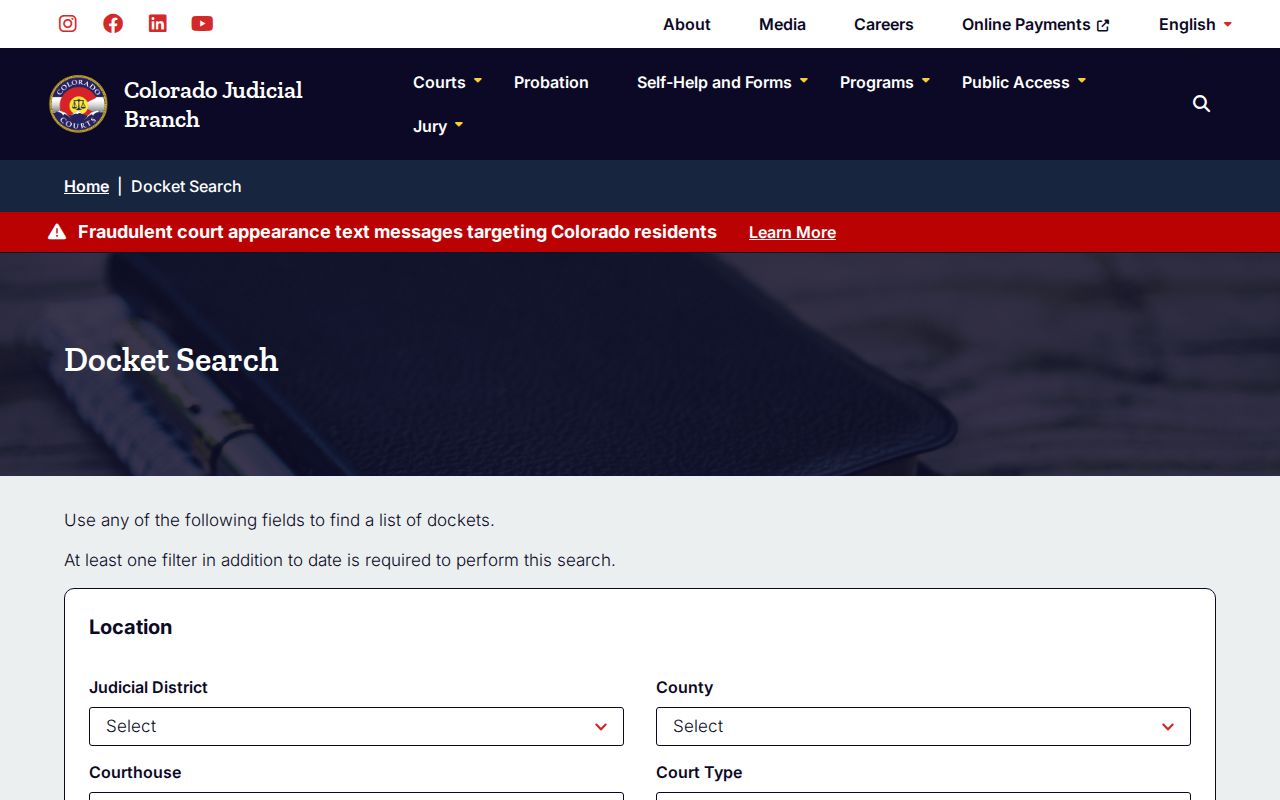
Use the displayed fields to narrow the correct case, then take the case number to the Washington Combined Court Clerk for a status answer.
Warrant Search Fields Explained
The docket accepts court-location, case, party, and attorney information. Washington County warrant lookup results become more reliable when a case number or court type separates similar names. The site requires a date range plus at least one other filter, and no field is presented as a direct “active warrant” switch.
| Field Label | Type | Required | Notes |
|---|---|---|---|
| Judicial District | Dropdown | No | Choose the 13th Judicial District when district scope is useful. |
| County | Dropdown | No | Select Washington County to avoid results from other Colorado counties. |
| Court Type | Dropdown | No | Options include Both, County, and District. |
| Date Range | Dropdown | Yes in practice | Use it with at least one more filter. |
| Case Number | Year, class, sequence | No | Best when the citation or court notice supplies the complete identifier. |
| Party Name | Text | No | First and last name search can be used for an individual. |
Why Washington County Warrant Results Fall Short
A blank docket result is not proof that no Washington County warrant exists. The case may be municipal, outside the chosen date range, sealed, protected, recently entered, or indexed under a different name. Colorado also has no public statewide name-searchable warrant database that can fill every gap.
The Washington County-selected interface can make the local filter easier to set. The county-filtered docket shown below should still be treated as a calendar and case-finding tool.
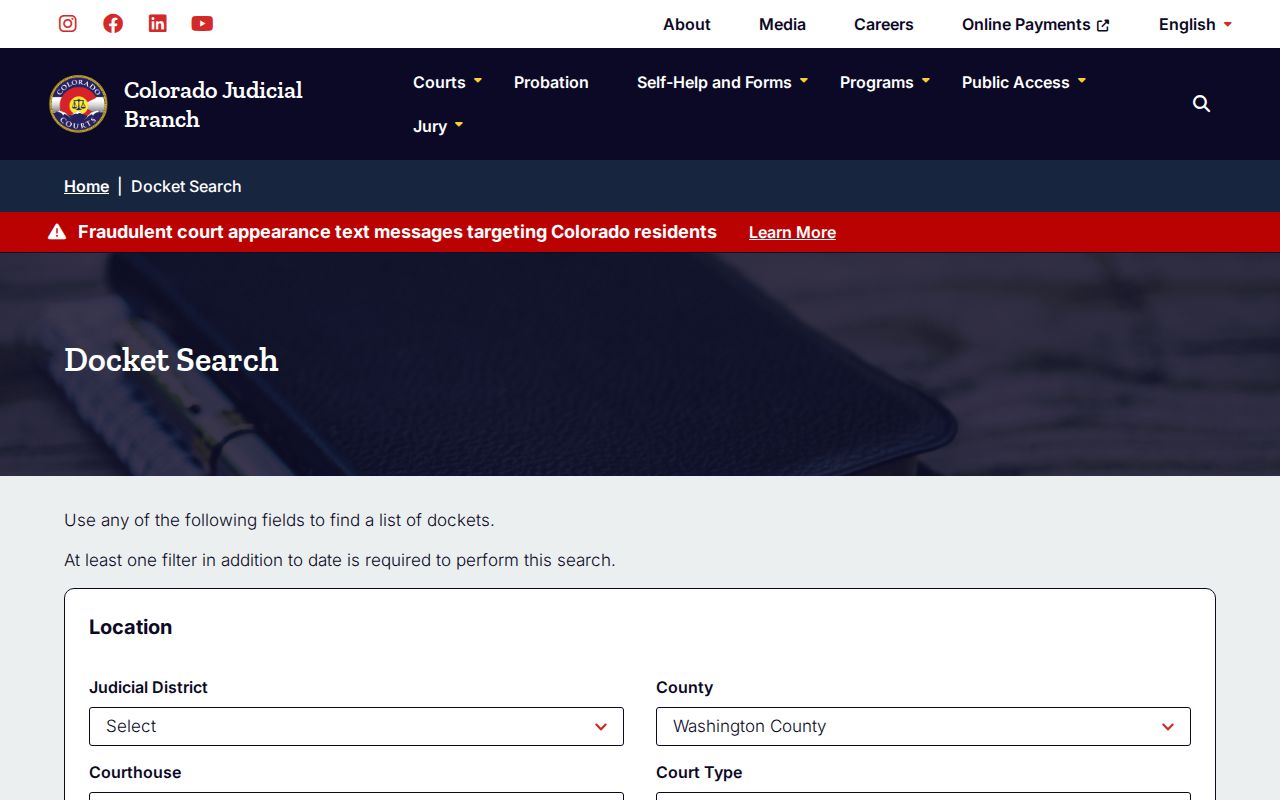
After locating a likely case, ask the clerk whether a warrant is active, served, recalled, or quashed and whether law enforcement has received the latest order.
What a Warrant Search Shows
A docket match may display a case number, date, time, hearing type, appearance type, courtroom, duration, and a party heading. A separate warrant-related document can carry the process type, issuing court, allegation or reason, bond terms, status, and service return. Washington County has not published a local warrant-number format or public active-list schema, so the table describes official record concepts rather than a hosted roster.
| Case Number | A Colorado identifier with year, case class, and sequence, such as the form example 2023AA123456. |
|---|---|
| Hearing Type | May include an appearance connected with an arrest warrant, but does not alone prove current status. |
| Issuing Court | District Court, Washington County Court, Akron Municipal Court, or Otis Municipal Court. |
| Bond | Amount and allowed type are case-specific and must come from the court. |
| Status | May be described as active, served, recalled, quashed, vacated, satisfied, or closed. |
Washington County Warrant Records Request
When the docket does not supply enough detail, use the Colorado court Record/Document Request Form. It asks for contact details, court location, party and case information, a date range, and the requested document. Useful choices can include the register of action, complaint or information, ticket, disposition or sentence order, bond order, or warrant-related court entry.
The official form image below highlights those fields and fee or certification choices. A request seeks records only; it does not pause enforcement or cancel a warrant.
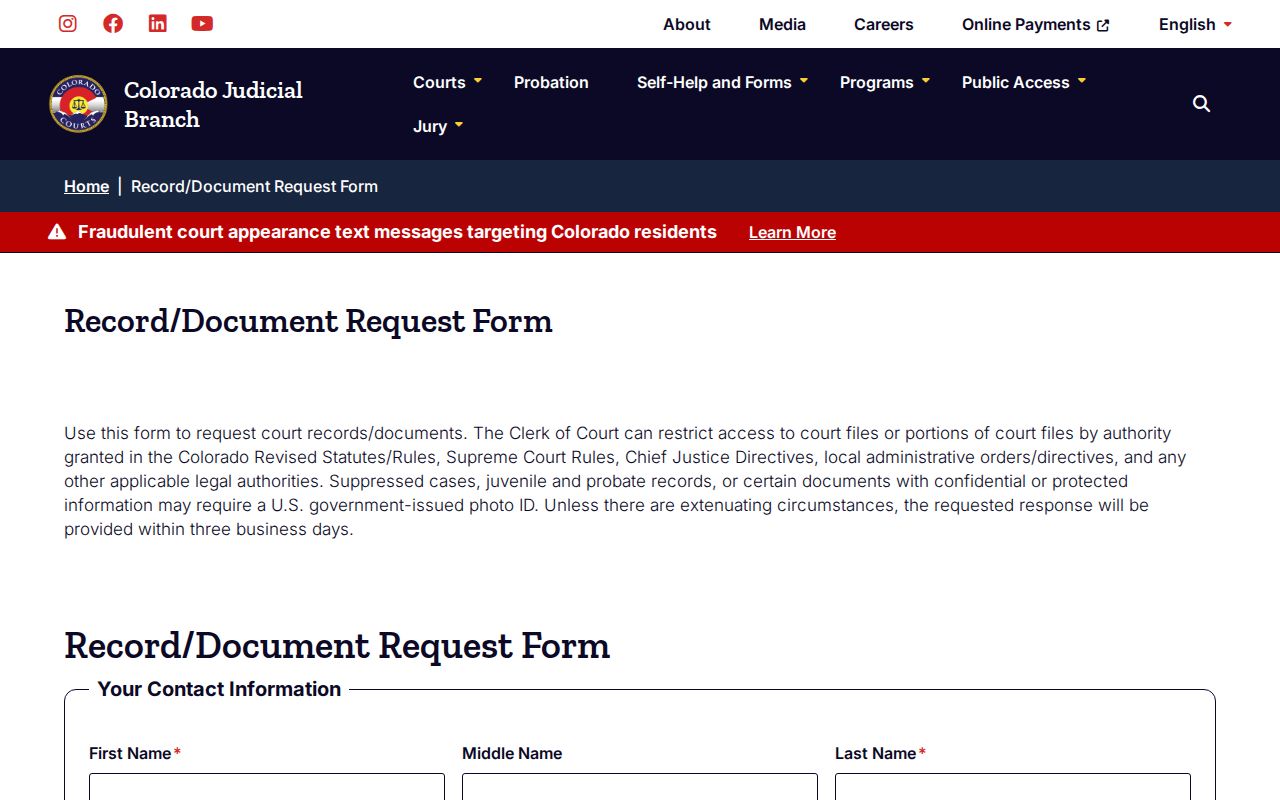
The form generally states a response within three business days unless circumstances require longer. Ask for a cost estimate if the scope may be large, and do not send sensitive details to an unverified address.
Where to Check Warrants in Washington County
The Washington Combined Court Clerk holds District and County Court files and can explain docket entries, warrant hearings, bond orders, and case documents. The Washington County Sheriff and Justice Center handle the local enforcement and custody side. Because the Sheriff publishes no searchable roster or warrant-specific form, confirmation depends on a call to 970-345-2244 and the issuing court.
Akron and Otis Municipal Courts control their own ordinance and municipal traffic matters. Colorado offers a statewide docket search but no single public statewide warrant index. An outside-county or federal matter must be checked with the court and agency that issued it. The Washington County outstanding-warrant process explains why case status and warrant status should be confirmed separately.
Washington County Warrant Request Routing
Washington County has a specific records-request route at Colorado Judicial's county request page. It points requesters to WashingtonRecordsRequest@judicial.state.co.us and the statewide form. Include the case number if known, the party name, date of birth when appropriate, court location, relevant dates, and a precise document description.
The captured county page below shows the Washington-specific email and form route. It is useful when a general docket query cannot expose the underlying filing.
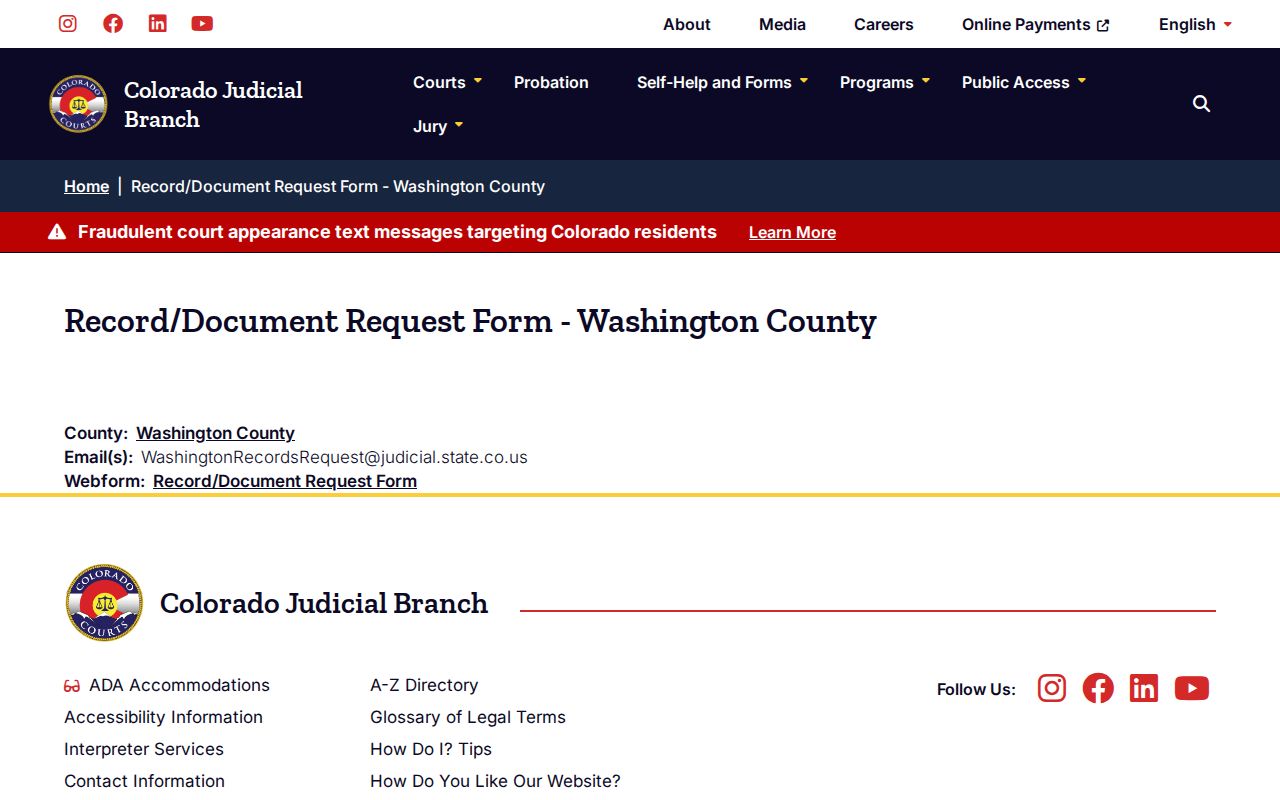
Requesting a narrow record can reduce delay and cost. Once received, compare the document with the clerk's current status answer because a historical warrant event can remain in a case file after recall.
Washington County Warrant Clerk Questions
A focused Combined Court call can separate a docket clue from live process. Ask for the exact court and case number, whether the file shows an active warrant, what triggered it, and what the judge requires next. Also ask whether bond or a reinstatement amount has been set and whether counsel may arrange an appearance or file a motion.
If the clerk reports a recall or quash, ask when the order was entered and sent to the Washington County Sheriff. Keep the order, court email, receipt, bond paper, and next-date notice. That record helps address a lag between the court file and enforcement system without assuming either source updates at once.
Restricted Warrants and Access Rules
Colorado court records are governed by Judicial Branch access rules, while CORA and the Colorado Criminal Justice Records Act govern other public and criminal justice records. Public access can be limited by statute, court order, privacy interests, security concerns, or an active investigation. Juvenile records receive special protection, and sealed or suppressed warrant material may not appear online.
Key Rules:
Sealed or suppressed warrants and affidavits can remain outside ordinary public inspection.
Juvenile and protected family information may be withheld or heavily redacted under Colorado law.
An unserved warrant or sensitive investigation may not be visible, so no result is not a clearance certificate.
The Judicial Branch access guide explains access limits, fees, and contact routes. Requesters should seek only the record needed and respect redactions rather than attempting to reconstruct protected personal data.